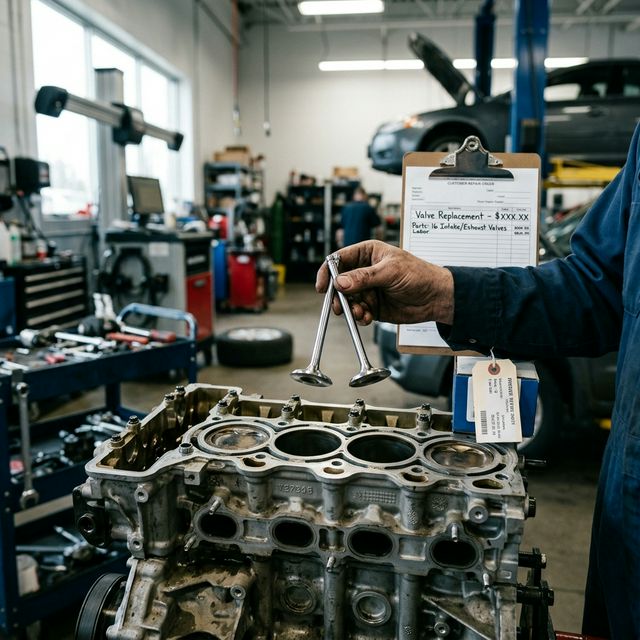
When an engine begins to lose compression or misfire, vehicle owners and mechanics alike brace themselves for the repair bill. A question we hear constantly in the automotive aftermarket is exactly how much it costs to replace car valves and why the final price tag is often so high.
In this article, our engineering team relies on over twenty years of direct manufacturing experience, along with the latest 2025 industry data, to break down the true costs of a valve replacement. We will explore the exact labor hours involved for different engine types, present real-world cost benchmarks, and explain how automotive professionals can dramatically reduce rebuilding costs while strictly maintaining factory-level OEM quality.
Parts vs. Labor in 2025
Parts Cost: Surprisingly Affordable
If you look at the physical metallic component itself, an individual engine valve is actually quite inexpensive. According to industry pricing data from multiple U.S. aftermarket sources, a single high-quality aftermarket intake valve or exhaust valve typically costs between $20 and $50, depending on the specific vehicle application (MechBasic, CostHack).
This applies to engines ranging from standard passenger vehicle applications like the Toyota 1ZZ-FE all the way up to heavy-duty commercial Cummins diesel engines. Even for a common 4-cylinder engine with 8 valves, the total parts cost for a full set of replacement valves may only be $160 to $400.
Total Repair Cost: Where the Real Expense Lies
However, the total valve job cost at most repair facilities typically ranges from $1,000 to $2,500 in 2025, with an average valve job coming in around $835 for simpler applications involving up to eight valves and approximately seven hours of labor (CostHack). If additional components such as the cylinder head, head gasket, or valve seats require resurfacing or replacement, the total can exceed $2,800 or more.
Here is a realistic cost breakdown for a typical 4-cylinder valve job in 2025:
Cost Component | Estimated Range (USD) |
|---|---|
Engine valves (set of 8) | $160 – $400 |
Valve stem seals | $30 – $80 |
Head gasket set | $100 – $350 |
Machine shop (valve grinding, seat cutting) | $150 – $350 |
Labor (7–10+ hours × shop rate) | $840 – $1,500+ |
Total Estimate | $1,280 – $2,680 |
Key Insight: Parts typically represent only 15–25% of the total valve replacement bill. The remaining 75–85% comes from labor charges. This cost structure creates a significant opportunity for shops and distributors to optimize their parts sourcing.
Are Engine Valves Hard to Replace?
Yes — replacing an engine valve ranks among the most labor-intensive repairs on any modern car. Accessing the internal valvetrain components demands a major engine teardown from a highly skilled professional.
Flat-Rate Labor Hours by Engine Type
According to standard flat-rate labor guides used across the U.S. auto repair industry, here is how long a complete valve job typically takes:
Engine Type | Estimated Labor Hours | Labor Cost @ $140/hr |
|---|---|---|
Inline 4-Cylinder (e.g., Honda K24, Toyota 1ZZ) | 7 – 12 hours | $980 – $1,680 |
V6 Engine (e.g., Toyota 2GR-FE, Nissan VQ35DE) | 12 – 18 hours | $1,680 – $2,520 |
V8 Engine (e.g., Ford Coyote 5.0, GM LS3) | 15 – 22 hours | $2,100 – $3,080 |
Commercial Diesel (e.g., Cummins ISB 6.7) | 18 – 25+ hours | $2,520 – $3,500+ |
2025 Labor Rate Data: According to Identifix's nationwide survey, the average U.S. mechanic shop rate reached $142.82/hour in 2024, and the AAA network reports that nearly half of all auto repair shops now charge between $120 and $159 per hour in 2025 — a roughly 10% increase year-over-year (Identifix, AAA). Dealerships typically charge $125–$250/hour, while independent shops range from $70–$120/hour.
Why It Takes So Long
The extensive labor is justified by the complexity of the teardown process:
Drain & Disassemble (2–3 hours): The mechanic must drain all coolant and engine oil, then painstakingly remove the intake manifold, exhaust manifold, fuel injection rail, and all wiring harnesses.
Cylinder Head Removal (3–5 hours): The technician must remove the timing chain or timing belt with extreme care to avoid piston-to-valve interference, then unbolt and lift out the entire cylinder head assembly.
Machine Shop Work (3–5 hours off-site): Often the cylinder head is sent to a specialized machine shop for valve grinding, seat cutting, guide inspection, and surface resurfacing. This alone can add $150–$350 and several additional hours.
Valve Installation & Precision Seating (2–4 hours): The new engine valves must undergo precision lapping and seating to ensure an airtight 45-degree angle seal against the valve seats. Mechanics must also replace the valve stem seals and head gasket during reassembly.
Reassembly & Timing Synchronization (2–4 hours): The technician must perfectly resynchronize the timing system, torque all fasteners to factory specification, refill fluids, and perform a compression test to verify the repair.
Because labor easily exceeds 10+ hours on most engines, the mechanic's hourly charges make up the vast majority of the final bill.
Why Smart Sourcing Matters
The global automotive engine valve market was valued at approximately USD $5.45 billion in 2024 and is projected to reach $5.66 billion in 2025, according to Grand View Research. With the aftermarket segment driven by an aging global vehicle fleet, the demand for high-quality, competitively priced replacement valves continues to grow.
For auto repair networks, engine rebuilders, and auto parts distributors, this reality creates a clear opportunity: labor costs remain largely fixed based on standard shop manuals, so the primary lever to increase absolute profit margins is to source premium engine valves at true factory-direct wholesale prices — without sacrificing quality.
How Distributors Can Optimize Costs
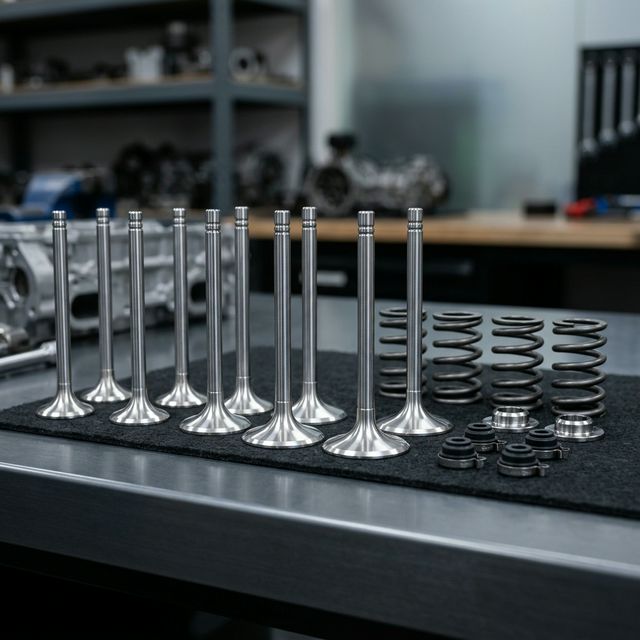
As an IATF 16949 certified manufacturer with over two decades of direct casting and forging experience, TOPU provides comprehensive commercial valve replacement kits and individual intake and exhaust valves that perfectly match OEM geometry.
Built to Withstand Extreme Conditions
Engine valves operate under some of the most extreme conditions inside any mechanical system. Exhaust valve heads routinely reach temperatures of 1,200–1,500°F (649–816°C), while intake valves operate in the 650–950°F (343–510°C) range (ASTM, SB International). Choosing the right material is critical.
TOPU's material selection is backed by decades of metallurgical expertise:
Application | Material Type | Key Property | Max Service Temperature |
|---|---|---|---|
Intake Valves | Martensitic steel (e.g., SUH3) | High hardness, wear resistance | ~600°C (1,112°F) |
Exhaust Valves | Austenitic steel (e.g., SUH35 / 21-4N) | Superior high-temp strength, oxidation resistance | ~800°C (1,472°F) |
High-Performance Exhaust | Nimonic 80A / Inconel alloys | Extreme creep resistance | ~850°C+ (1,562°F+) |
Technical Note: SUH35 (21-4N) austenitic steel — the industry standard for exhaust valves — retains a tensile strength of approximately 75 kg/mm² at 500°C and still maintains 34 kg/mm² at 850°C, ensuring reliable sealing even under sustained high-temperature operation (Engine Australia, GS Valves UK).
TOPU Quality Advantage

100% Full-Size Online Laser Inspection: Every single valve produced passes through automated dimensional verification to guarantee micro-finished, drop-in fit — saving mechanics critical machining time during installation.
Precision Forging Technology: Our automated blank production lines combined with micron-level precision grinding ensure dimensional accuracy within OEM tolerances.
Comprehensive Coverage: From highly popular Japanese sedans (Honda K24 series, Toyota 1ZZ-FE) to American workhorses (Ford Coyote V8) and global commercial diesel trucks — TOPU covers thousands of applications.

The Bottom Line: Cost Optimization
While repairing engine valves requires deeply complex labor (often $1,000–$3,000+ in mechanic charges alone) and carries a hefty repair bill, sourcing the absolute best aftermarket parts is actually very easy — and it is the single most effective way for automotive businesses to protect margins.
By partnering with a rigorously tested manufacturer like TOPU, automotive businesses access top-tier internal engine components that:
✅ Meet or exceed OEM dimensional and metallurgical specifications
✅ Reduce installation time with precision pre-finished valve seats
✅ Carry IATF 16949 quality certification for full traceability
✅ Are priced at true factory-direct wholesale, maximizing per-job profitability
Ready to Optimize Your Engine Valve Supply Chain?
We invite you to contact TOPU Engine Parts today for wholesale pricing and OEM-quality valve replacements.
📧 Email: [email protected]
📱 WhatsApp: +86 138 6266 4011
🌐 Visit Our Website: www.e-topu.com
Data sources cited in this article include AAA (aaa.com), Identifix (identifix.com), CostHack (costhack.com), MechBasic (mechbasic.com), Grand View Research (grandviewresearch.com), ASTM International (astm.org), Engine Australia (engineaustralia.com.au), and GS Valves UK (gsvalves.co.uk). All cost figures are based on 2024–2025 U.S. market averages and may vary by region and vehicle application.